From Broken Beginnings to the Open Skies
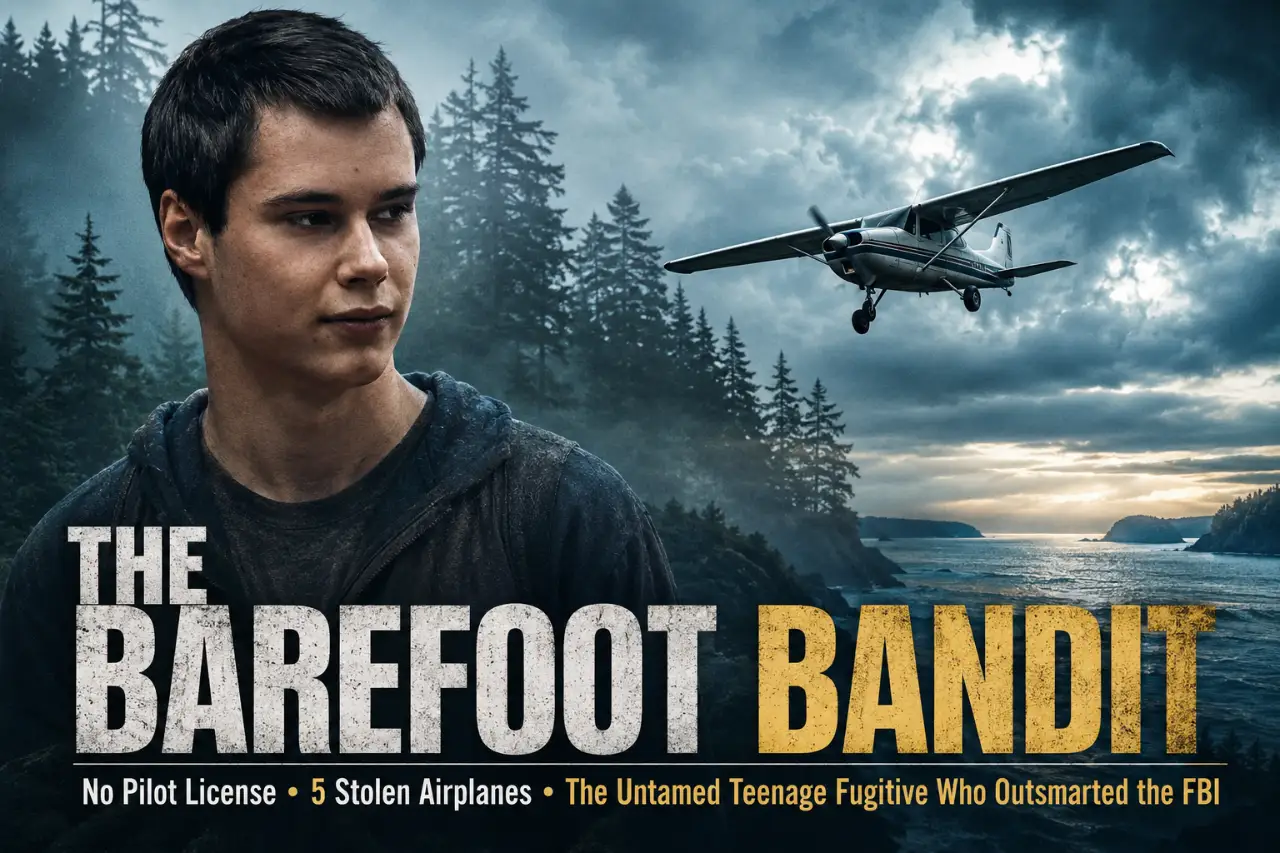
Growing up amidst the dense, fog-covered forests of Camano Island in Washington State, Colton Harris-Moore’s early life was defined by extreme neglect, isolation, and domestic instability. With little structure and virtually no guidance, he began breaking into local vacation homes at the age of twelve, initially searching for basic survival necessities like food, blankets, and dry clothes. What began as small-scale break-ins quickly escalated into an obsessive obsession with machinery, luxury vehicles, and, most remarkably, aviation. In April 2008, after escaping from a halfway house, the seventeen-year-old vanished entirely into the Pacific Northwest wilderness, living off the grid like a phantom. Despite having no formal flight training, aviation background, or licensed instruction, Colton bought commercial flight instruction manuals, studied aviation DVDs, and practiced on basic computer flight simulators using stolen credit cards. In November 2008, he broke into a private airport hangar, hot-wired a single-engine Cessna 182, and took off into the stormy night sky. Over the course of the next two years, he stole and successfully flew at least five airplanes across North America, crashing each one during precarious emergency landings yet miraculously walking away from the twisted wreckage without a single life-threatening scratch.

The Rise of a Global Folk Legend and the High-Stakes Hunt
As law enforcement agencies scrambled to track him down, Colton’s elusive nature and bizarre signature earned him the world’s attention. He frequently burglarized high-end properties, marinas, and airfields completely barefoot, occasionally leaving behind chalk outlines of his bare feet alongside taunting handwritten notes for local detectives. Because of these distinct footprints, the media and police dubbed him "The Barefoot Bandit." To the Federal Bureau of Investigation (FBI), the Department of Homeland Security, and the Royal Canadian Mounted Police, he was a dangerous and unpredictable serial felon who posed serious risks to public safety and airspace regulations. However, across the internet and international social media platforms, a radically different narrative emerged. An active Facebook fan club attracted tens of thousands of global followers from North America, Germany, the United Kingdom, and across Europe, where spectators began viewing him as a modern-day folk anti-hero—a teenage Robin Hood defying modern corporate surveillance and governmental authority with barefoot cunning and fearless audacity. Merchandise bearing his silhouette sprang up online, and international news networks broadcast regular live updates tracking his seemingly impossible transcontinental flight paths.
The Final Island Showdown and the Path Beyond the Legend
The international manhunt reached its cinematic climax in July 2010 after Colton stole a high-performance Cessna 400 aircraft from an Indiana airfield and navigated it over a thousand miles across open ocean waters toward the Caribbean. When fuel ran out, he crash-landed the plane into shallow coastal waters near Great Abaco Island in the Bahamas and slipped silently into the mangrove swamps. Days later, Bahamian police cornered him in a high-speed nautical pursuit after he hijacked a 44-foot powerboat near Harbour Island. Following a tense standoff where officers shot out the boat’s outboard engine, nineteen-year-old Colton Harris-Moore threw his hands up, ending an extraordinary multi-year evasion that spanned thousands of miles and captured global headlines. Extradited back to the United States, he pleaded guilty to federal and state charges, expressing genuine remorse for the property damage and chaos he caused, and was sentenced to more than seven years in prison. After serving his time with exemplary conduct and working tirelessly to pay full court-ordered restitution to his victims, Colton earned his release in 2016. Today, his incredible saga remains one of the most astonishing true-crime chapters in modern aviation history, standing as an enduring testament to raw human resourcefulness, youthful rebellion, and the untamed desire for absolute freedom.
References
- Federal Bureau of Investigation (FBI) Press Release: Colton Harris-Moore Sentenced in Seattle Federal Court (December 2011)
- The New York Times: A Folk Hero at 19, the Barefoot Bandit Gets More Than 7 Years by William Yardley
- BBC News: Profile of Colton Harris-Moore, the Barefoot Bandit
- CNN Special Report: The capture and extradition of the Barefoot Bandit in the Bahamas (July 2010)
- Book: The Barefoot Bandit: The True Tale of Colton Harris-Moore by Bob Friel (Hyperion Books, 2012)