The Vanishing Woman and the Blurred Line Between Screen and Reality
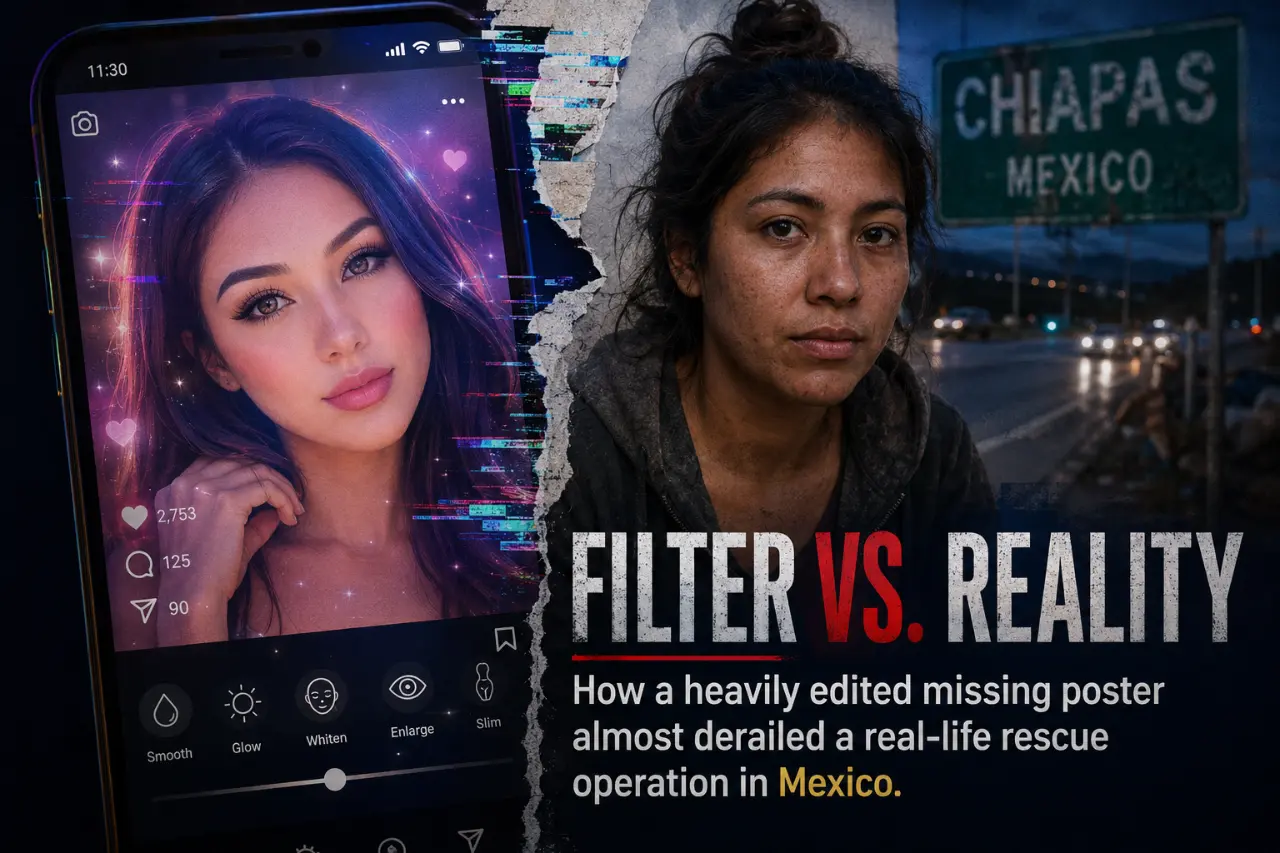
On a quiet night in Chiapas, Mexico, thirty-year-old Grecia Guadalupe Orantes Mendoza stepped out of view and vanished into thin air. Within hours, her worried family triggered one of Mexico’s most critical missing-person mechanisms: the Alba Protocol. Authorities rushed to print official search bulletins, blast urgent alerts across social media, and flood regional checkpoints with her portrait. Yet, as the official poster circulated nationwide, a bizarre and chilling obstacle emerged. The photograph chosen by investigators—pulled directly from Grecia’s social media—was so heavily altered by digital beauty filters, AI skin-smoothing, and artificial facial reshaping that the person on the poster looked almost nothing like the woman walking the streets. Her natural facial contours, true skin tone, and distinctive traits were completely swallowed by algorithms designed to sell an impossible, polished aesthetic. Instead of providing the public with an accurate roadmap to spot a woman in grave danger, the search campaign broadcasted a digital avatar, leaving regular citizens and field officers with a visual puzzle rather than an actionable lead.

A Miracle by the Highway and the Shock of the Unfiltered Truth
For days, the search hung in a state of tense uncertainty across the mountainous roads between Ocozocoautla and Jiquipilas. Every passing hour in a missing-person investigation exponentially reduces the odds of survival, and the distorted posters only added confusion on the ground. Then came an unexpected wave of relief: search teams discovered Grecia alive on the side of a rural highway. Paramedics and state prosecutors immediately secured her safety, offering urgent medical checks and psychological support. But as authorities released the official, unedited photograph confirming her safe recovery, a new shockwave rippled across the internet. The side-by-side comparison between her real, authentic face and the hyper-filtered missing bulletin was startling. Thousands of viewers who had shared the alert admitted they never would have recognized her in person. What was meant to be a straightforward celebration of survival instantly turned into an international viral sensation, sparking fiery discussions from Mexico City to Berlin and New York.
The Lethal Cost of Digital Vanity in a High-Stakes World
Grecia’s story had a joyful resolution, but it exposed a dangerous fault line at the heart of our modern, image-obsessed culture. We live in an era where millions of people subtly distort their everyday appearance behind augmented reality lenses, softening jawlines, enlarging eyes, and wiping away the raw textures that make human faces uniquely recognizable. While seemingly harmless for an Instagram feed, this collective obsession with digital perfection becomes a life-or-death liability the moment real-world identification is required. Forensic experts and search organizations are now issuing urgent warnings: in emergencies, an unpolished, raw, high-resolution snapshot is worth infinitely more than a dozen flawless portraits. Grecia’s case stands as a wake-up call for the global digital generation. When life hangs in the balance, our real, unfiltered faces are not just identities we carry online—they are the only lifeline that can guide rescuers back to where we truly are.
References
- Fiscalía General del Estado de Chiapas Official Search Record File 01S/CEBP/212/2025
- Protocolo Alba Chiapas Urgent Activation Report for Grecia Guadalupe Orantes Mendoza
- El Heraldo de México National News Report Hallan con vida a Grecia Orantes en Chiapas
- Radio Fórmula Mexico Investigation on Missing Person Filtered Alert Bulletins
- Diario de Morelos Forensic Identification and Social Media Imagery Analysis Report
- Eje Central Coverage on Search and Rescue Protocols along Ocozocoautla-Jiquipilas Highway