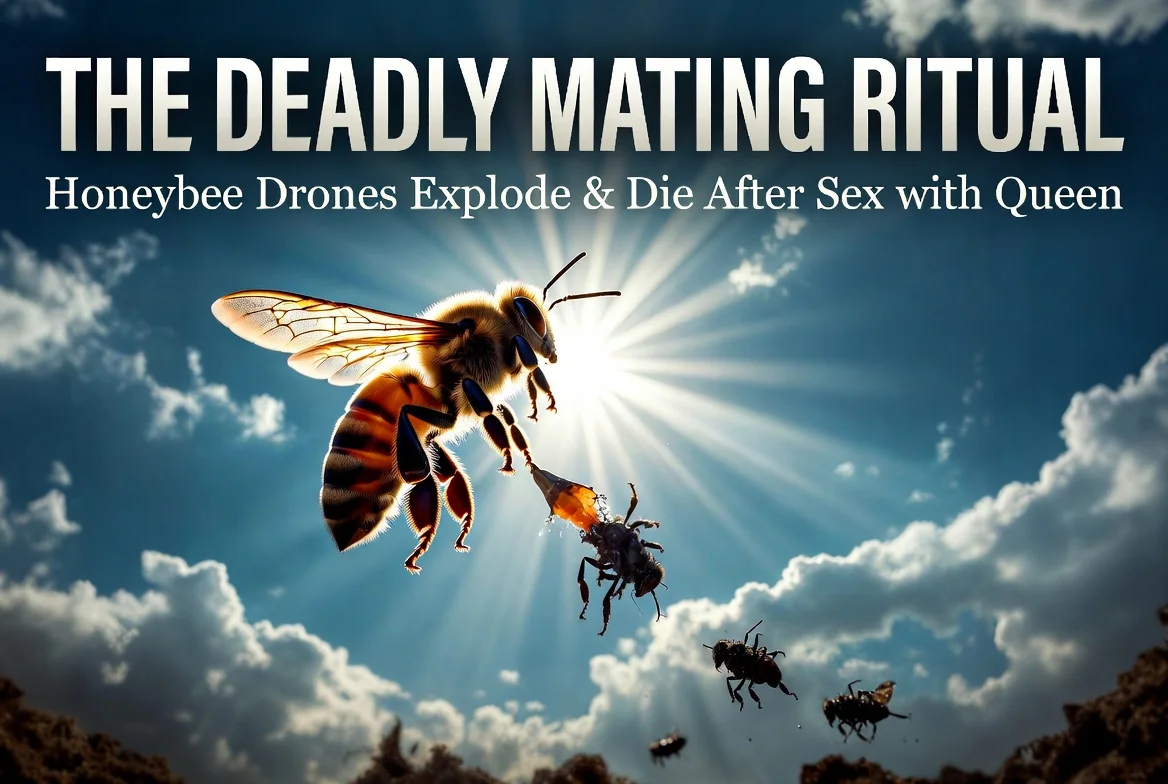
Explosive Death Awaits Male Honeybees in Queen Mating Flight
In the skies over honeybee colonies, male drones face a fatal destiny during the queen’s nuptial flight. Virgin queens leave the hive to mate in drone congregation areas high above the ground. A drone catches the queen mid-air, grasps her with all six legs, and everts his endophallus using abdominal contractions and hemolymph pressure. The ejaculation is explosive, blasting semen into the queen’s oviduct with such force that it often produces an audible popping sound. The endophallus ruptures instantly; its bulb breaks off and remains lodged inside the queen as a mating plug. The drone’s abdomen tears open from the strain, paralyzing him. He flips backward and falls to the ground, dying within seconds. The entire mating lasts less than five seconds. Drones possess no stinger and serve only this reproductive role. The ruptured organ ensures they mate just once. This mechanism, observed in scientific studies, guarantees sperm transfer from the fastest, strongest males. Dead drones litter the ground after each flight, their reproductive organs left behind. The process is a brutal yet precise adaptation that secures genetic material for the colony while eliminating unsuccessful suitors immediately.
Queen’s Multiple Matings Create Trail of Dead Drones
A single queen mates with five to nineteen or more drones during one afternoon flight. Each successful drone leaves a mating sign that the next male must physically remove before inserting his own endophallus. The queen stores up to 100 million sperm in her oviducts, retaining about six million in her spermatheca for lifelong use. This polyandry provides essential genetic diversity, improving colony resistance to disease and environmental stress. The queen flies to distant congregation areas to avoid inbreeding. After mating, she returns to the hive and begins laying eggs fertilized by the mixed sperm supply over years. Meanwhile, each drone that mates dies on the spot, contributing to a visible trail of corpses. Non-mating drones face later eviction by workers in autumn, who stop feeding them to conserve resources for winter. The queen’s strategy maximizes reproductive success while the drones’ sacrifice ensures only elite genetics enter the gene pool. This serial mating system has been confirmed through detailed behavioral and anatomical research on Apis mellifera.
Nature’s Ruthless Strategy Sacrifices Drones for Hive Survival
The explosive mating death of drones represents an evolutionary trade-off optimized for colony persistence. By dying immediately after mating, drones prevent resource waste on males that have completed their genetic contribution. The mating plug left inside the queen reduces sperm leakage and may briefly deter additional matings, giving each drone a competitive edge. Haploid drones develop from unfertilized eggs, making their sole purpose the transmission of genes during high-stakes aerial chases. Workers later expel surviving drones to starve, prioritizing the queen and future brood. This eusocial system channels all male effort into one brief, fatal act that benefits the superorganism. The result is a resilient colony capable of producing millions of offspring from a single queen’s stored sperm over seven years. Such ruthless efficiency has allowed honeybees to thrive worldwide despite the high individual cost to males. The phenomenon underscores how natural selection favors traits that serve group survival even when they demand total self-sacrifice from half the population.
References
- Wikipedia: Drone (bee)
- Orkin: Mechanics of Honey Bee Mating
- ThoughtCo: Sexual Suicide by Honey Bees
- PerfectBee: The Role of the Drone Bee
- M. L. Winston: The Biology of the Honey Bee (1987)